
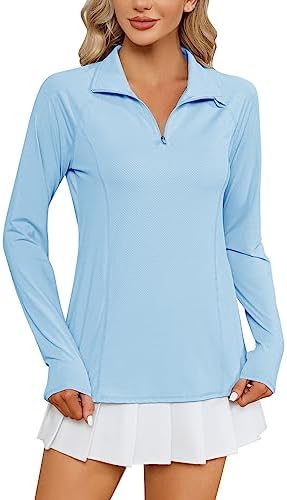
 Women's Long Sleeve Shirts Sun Protection 1/4 Zip Summer Quick Dry HikingA quick dry quarter zip pullover in clear blue, cut with a stand collar, long sleeves with thumb holes, and side pockets. 4.4 out of 5 · 2,453 ratings$18.99
Trail notes
Why a long sleeve works on bright trails
We cut 18 pieces for bright trails and open ground. A long sleeve covers the arms without trapping heat when the cut stays loose. Air moves through an open weave while the cloth casts its own shade. These notes explain how our collars, zips, cuffs, and drop hems are put together.
How air moves through a loose sleeve
A sleeve that hangs away from the arm carries shade wherever you walk. A light open weave lets the breeze pass straight through the yarns, while a dense weave holds the heat close to the seam lines. We cut the armholes with room to spare so the cloth does not press against the armpit during a long stride. When the forearm has space inside the sleeve, the movement of walking pumps air up toward the shoulder. Tight layers cling and stop that air from moving. A relaxed cut keeps the cloth off the forearm and lets fresh air reach the upper arm.
What the zip and collar do
A standing collar covers the back of the neck where low branches or direct light hit first. A fold-down collar lies flat under a pack strap without bunching up at the neck seam. The quarter zip on our trail tops drops low on the chest placket. Pulling the slider down opens the neck wide enough to let heat rise away from the chest. The teeth sit flat behind a fabric facing so the metal or plastic stays off the collarbone. When the wind picks up, pulling the zip to the top brings the collar close around the throat without pulling the shoulders tight.
Thumb loops and cuffs on the trail
A plain cuff finishes at the wrist bone with a flat turned hem. Other cuts add a thumb loop set into the inner sleeve seam to keep the cuff over the back of the hand while you reach forward. When you use trekking poles, the hands stay high and sleeves tend to creep up the forearm. The loop holds the wrist edge steady against that pull. If you want the forearm bare, the cuff pushes up easily because the wrist opening is not bound with tight elastic. The flat sleeve hem rolls twice and sits neatly below the elbow when pushed up.
How the hem lands and stays put
Our trail pieces use either a level bottom hem or a drop hem that falls lower at the back. A level hem sits square with the waistband of a pair of shorts. A drop hem adds extra length behind so the cloth does not pull above the belt line when you lean forward over a pack or bend to tie a boot lace. The side seams finish with small reinforcement stitches at the base where the two panels meet. That extra stitching keeps the split from tearing when the hips move. The front hem stays high enough to avoid gathering in front.
What quick dry means on the cutting table
Quick dry is not a chemical rinse or a surface finish that washes out over time. It is a construction fact about the yarn and the weight of the cloth. We use a thin synthetic yarn that holds almost no moisture inside its core. Water stays on the surface of the flat fibers and evaporates quickly because there is very little cloth mass to soak through. That is why these pieces feel slight in the hand when you lift them off the table. A trail shirt will not keep you warm in cold weather. It is built for cover on open ground.
- We cut 18 pieces in the sun and trail section.
- The full LOMON catalogue holds 254 pieces across 7 sections.
- A quarter zip opens down the chest placket to vent air.
- A drop hem cut longer at the back stays below the waistband.
- A thumb loop sewn into the cuff seam holds the sleeve over the hand.
From this section
Pieces the note is about
Women's Long Sleeve Shirts Sun Protection 1/4 Zip Summer Quick Dry HikingA quick dry quarter zip pullover in clear blue, cut with a stand collar, long sleeves with thumb holes, and side pockets. 4.4 out of 5 · 2,453 ratings$18.99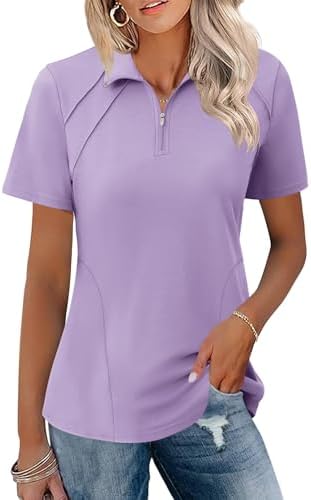 Golf Shirt for Women Short Sleeve Quarter Zip Polo Light Lilac, SA quarter zip short sleeve polo in light lilac stretch knit, cut with a spread collar, side pockets, and a curved hem. 4.2 out of 5 · 968 ratings$24.99
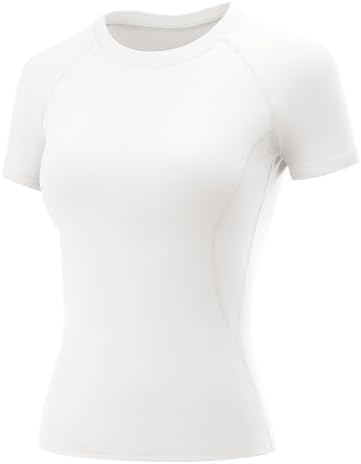 Athletic Tops for Women Short Sleeve Workout Shirts Dry Fit Running SlimA short sleeve athletic tee in white, cut with raglan shoulder seams and a crew neckline that sits flat against the collarbone. 4.5 out of 5 · 579 ratings$12.99
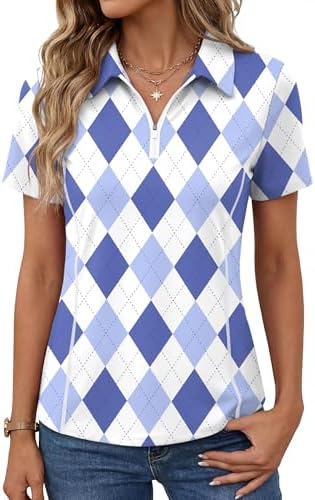 Womens Collared Golf Shirt Quick Dry Summer 1/4 Zipper Short Sleeve 2026A quick dry short sleeve polo cut with a soft folddown collar, quarter zip placket, and a purple and blue plaid print. 4.1 out of 5 · 453 ratings$19.99
All of Sun & Trail is on one page.
When to choose another layer
A trail layer offers cover on bright days, not warmth against a cold wind. When frost sits on the trail, switch to our knitwear and layers section. A thin top has no loft to hold warm air against the chest. Pick the piece cut for the weather you have.
See Sun & TrailKeep reading
Other postcards
What keeps the rain out of clothWe cut 21 pieces for the rain and wind section across our wider collection of 254 pieces. A shell sheds water because the face cloth carries a coating, while an untreated weave lets water soak through the yarns. How the seams, cuffs, and plackets are set decides what gets past the cloth.Where a neckline lands on the frameA cut begins at the neck and shoulders before cloth drops toward the waist. Across our tops and blouses rail, eighty-three pieces take their balance from where that opening rests against the collarbone and how the sleeve joins the body. Changing the seam placement alters the line of the entire garment.How to read a knit garmentWe cut our knitwear section for cold mornings, windy walks, and quiet rooms. A knit behaves differently from a woven shirt on the table and on the body. Reading the cuff, the shoulder seam, the facing, and the loops tells you how a piece hangs and how it traps warmth.