
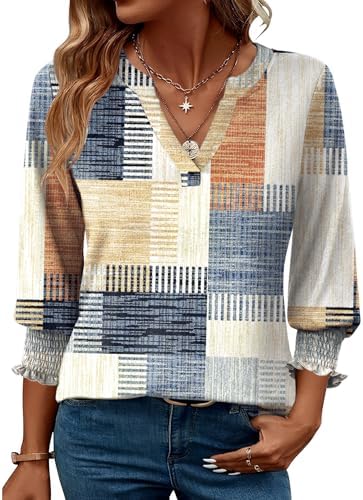
 Blouses for Women Dressy Casual 3/4 Sleeve Tops for Women V Neck T ShirtA woven V-neck blouse in an orange and blue print, finished with three-quarter smocked sleeves and soft ruffled cuffs. 4.3 out of 5 · 8,691 ratings$7.19
Cutting notes
Where a neckline lands on the frame
A cut begins at the neck and shoulders before cloth drops toward the waist. Across our tops and blouses rail, eighty-three pieces take their balance from where that opening rests against the collarbone and how the sleeve joins the body. Changing the seam placement alters the line of the entire garment.
Four ways we finish the neck
A crew sits close against the base of the neck, resting on the collarbone with a narrow band. Cut a v-neck and the opening drops down the centre front, changing where the eye travels and how the chest panel lies flat. A square neck cuts straight across the front with sharp right angles at the shoulder straps. A boat neck runs wide toward the shoulder points, leaving the collarbones bare while keeping the front and back high. Each shape calls for a different facing or rib to hold the edge flat through a cold wash without rolling inward.
Where the shoulder seam sits
The shoulder seam sets the structure for everything below it. A set-in sleeve places that seam squarely on the shoulder point, giving the armhole a clean pivot and keeping the front panel taut. When we drop that seam down the upper arm, the cloth relaxes across the chest and the armhole widens. A raglan removes the top seam entirely. It runs diagonal tracks from the underarm straight up to the collar band. That cut lets the arm move without pulling the hem upward, though it softens the square outline of the upper body.
Plackets, facings, and button bands
Look closely at the centre front of a woven blouse. A folded placket uses the main body cloth turned back on itself, creating a clean finish with minimal bulk along the buttons. A faced placket adds a separate strip of woven cloth behind the edge, giving the buttonholes extra body so they do not stretch under tension. Some pieces run buttons from the waist all the way to the stand collar. Others stop halfway down the chest in a popover cut, which holds its shape flat across the lower torso while keeping the neck open.
Set-in sleeves and cut-on sleeves
How the sleeve connects to the torso changes how cloth hangs at rest. A traditional set-in sleeve is cut as a separate tube and stitched into an oval armscye, which keeps excess cloth out from under the armpit. A cut-on sleeve, sometimes called a kimono or batwing cut, extends directly from the front and back panels without a dividing seam. It drapes softly when arms rest at the sides but creates loose folds of cloth under the arm. We choose between them based on how crisp or loose the top needs to fall.
The balance of tunic lengths
A standard tee hem stops near the hip bones. A tunic drops lower, running down past the seat to cover the upper thighs. Adding that length introduces a basic cutting trade. More cloth below the waist means the garment hangs straight from the chest, trading a defined waistline for extra coverage and room through the hip. We often add side vents to a long hem. Those small slits allow the lower panels to part when you sit, which keeps the cloth from pulling tight across the lap or bunching around the waistband.
- Our catalogue holds 254 pieces across 7 sections.
- The tops and blouses section contains 83 individual pieces.
- A crew neck finishes with a band resting on the collarbone.
- A boat neck opening extends wide toward both shoulder points.
- A raglan seam runs diagonally from the underarm to the collar.
From this section
Pieces the note is about
Blouses for Women Dressy Casual 3/4 Sleeve Tops for Women V Neck T ShirtA woven V-neck blouse in an orange and blue print, finished with three-quarter smocked sleeves and soft ruffled cuffs. 4.3 out of 5 · 8,691 ratings$7.19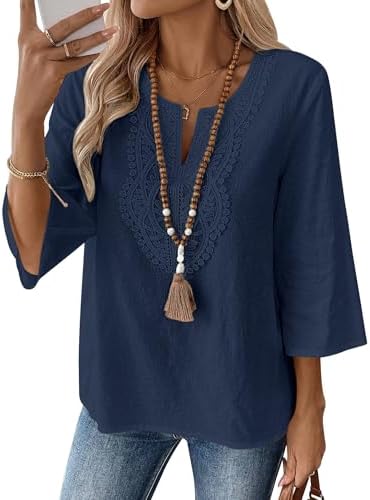 Women's 3/4 Sleeve Cotton Linen Shirts Casual V Neck Shirts Navy BlueCut from a lightweight cotton-linen blend with a deep blue dye, a lace-trimmed V-neckline, and easy three-quarter sleeves. 4.1 out of 5 · 3,028 ratings$16.99
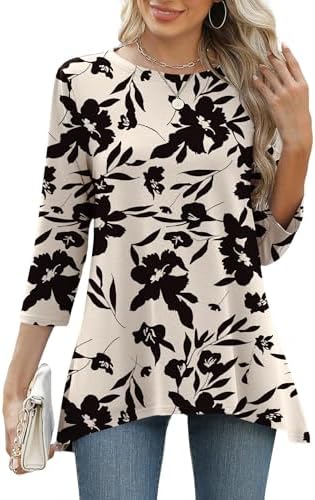 Women's Tops 3/4 Sleeve Dressy Casual Plus Size Tunic Tops to Wear withCut long with a flared swing hem, this three-quarter sleeve tunic is knit from a lightweight stretch jersey in soft apricot. 4.4 out of 5 · 2,930 ratings$12.99
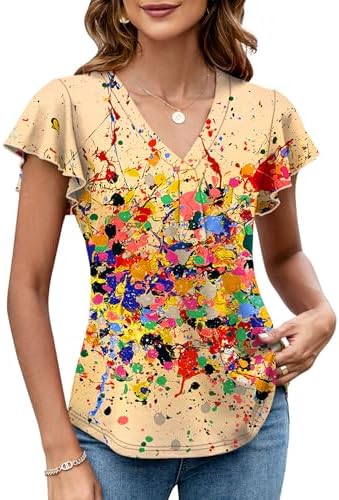 Ladies Tops and Blouses Loose Fit Petal Sleeve Tunic Plus Size MaternityA loose knit tunic top cut with overlapping petal sleeves, an open split neckline, and a rounded hem in a splashed ink print. 4.4 out of 5 · 2,431 ratings$9.99
All of Tops & Blouses is on one page.
Choosing the right upper cut
Match the neckline and shoulder to the layers you wear over it. A set-in shoulder fits under a tailored jacket without bunching. A dropped shoulder or wide boat neck sits best on its own or under an open front layer. Check the seam placement to know how the garment hangs.
See Tops & BlousesKeep reading
Other postcards
What keeps the rain out of clothWe cut 21 pieces for the rain and wind section across our wider collection of 254 pieces. A shell sheds water because the face cloth carries a coating, while an untreated weave lets water soak through the yarns. How the seams, cuffs, and plackets are set decides what gets past the cloth.Why a long sleeve works on bright trailsWe cut 18 pieces for bright trails and open ground. A long sleeve covers the arms without trapping heat when the cut stays loose. Air moves through an open weave while the cloth casts its own shade. These notes explain how our collars, zips, cuffs, and drop hems are put together.How to read a knit garmentWe cut our knitwear section for cold mornings, windy walks, and quiet rooms. A knit behaves differently from a woven shirt on the table and on the body. Reading the cuff, the shoulder seam, the facing, and the loops tells you how a piece hangs and how it traps warmth.